

How much is an eye test in the UK? 2026 prices explained

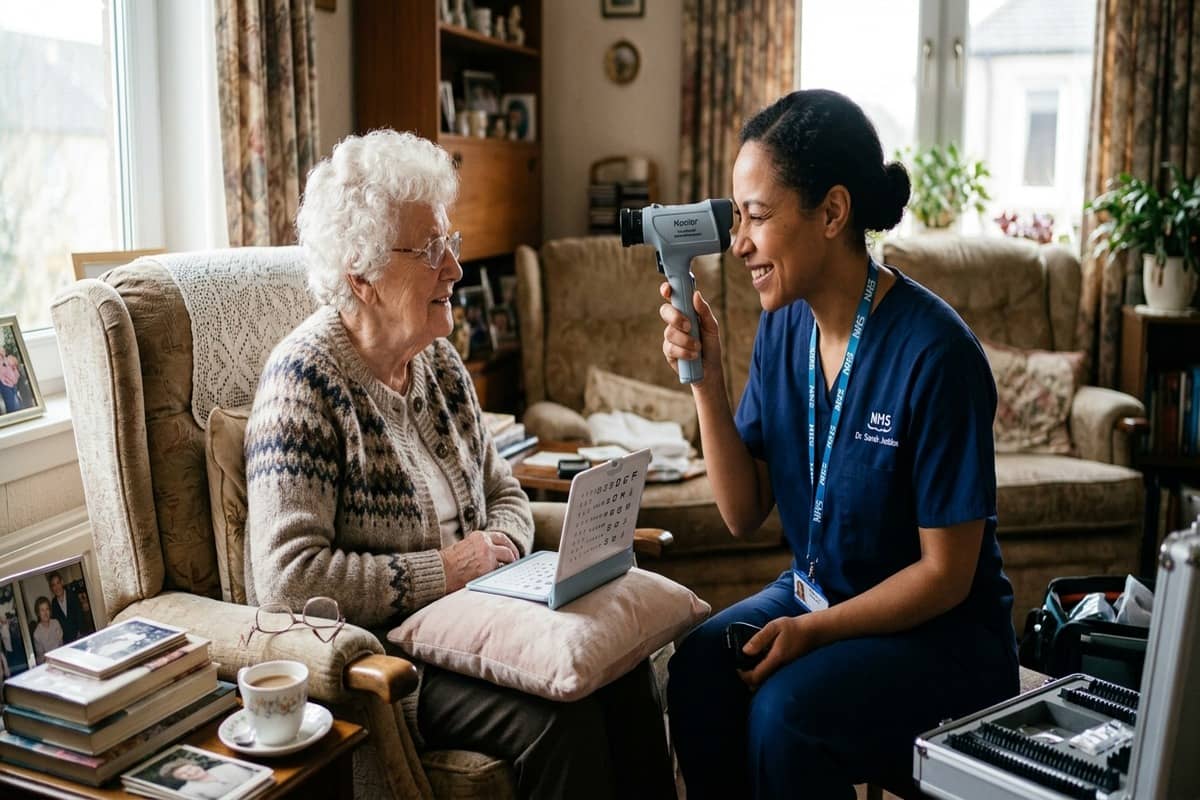
A private eye test in England, Wales or Northern Ireland usually costs between £25 and £40, and the large high-street chains we checked on 26 September 2026 listed their standard test at £24 to £29.95, often with offers that bring it lower. In England the NHS pays for your sight test if you are 60 or over, under 16, have diabetes or glaucoma, or fit one of several other groups, while in Scotland NHS eye examinations are free for everyone who usually lives in the UK. HomeSight, a home-visiting optician, charges £30 for a private eye test at home with no call-out fee, and the same visit costs nothing when the NHS funds it.
That is the short answer. The longer one matters because the test fee is rarely the whole bill. Scans, contact lens checks and glasses are priced separately, NHS help with glasses is narrower than most people expect, and the rules differ across the four nations. This guide sets out what you are likely to pay, what you can get free, and what changes if the test has to come to you.
The short answer
- High street, private: usually £25 to £40. Asda, Specsavers and Boots listed £24, £25 and from £29.95 when we checked.
- NHS, England: free for over-60s, under-16s, people with diabetes or glaucoma, and several other groups listed below.
- Scotland: NHS eye examinations are free for anyone who usually lives in the UK, whatever their age.
- Glasses: a free test does not mean free glasses. NHS optical vouchers go mainly to people on certain benefits or low incomes, children and young people in full-time education, and people who need complex (very strong) lenses.
- At home: free on the NHS if you qualify for a free sight test and cannot leave home unaccompanied because of illness or disability. Otherwise HomeSight charges £30, with no call-out fee.
How much is an eye test? UK prices at a glance
Opticians set their own private fees, so there is no single national price. The College of Optometrists, the professional body for optometrists, puts the usual range in England, Wales and Northern Ireland at £25 to £40 and advises checking with the practice before you book. The chain prices below are the ones each company published on its own website on 26 September 2026. Local practices may charge differently, and offers come and go.
| Type of appointment | Typical price | Notes |
|---|---|---|
| Standard private sight test, high street | £25 to £40 (College of Optometrists) | Asda £24. Specsavers £25, with a £10 offer in England, Wales and Northern Ireland until 31 October 2026. Boots from £29.95. |
| Sight test with an OCT scan | Around £30 to £55 | Vision Express’s Advanced Eye Test, which includes OCT, is £30. Specsavers adds up to £10 to its test. Boots from £54.95. |
| Contact lens check-up | Varies | Boots charges £50, or includes it in its contact lens plans. Ask whether your lens price already covers check-ups. |
| NHS sight test (England, Wales, Northern Ireland) | £0 if eligible | Eligibility is set out in the next section. |
| NHS eye examination, Scotland | £0 | For anyone who usually lives in the UK, plus some other groups. |
| NHS-funded home visit | £0 if eligible | You must qualify for a free sight test and be unable to leave home unaccompanied because of illness or disability. |
| Private home eye test, HomeSight | £30 | No call-out fee. Retinal photography included. London, the South East and the South Midlands. |
Prices checked on 26 September 2026 on each provider’s own price page. They vary by practice and change often, so confirm the total when you book.
Who gets a free NHS eye test in England?
In England the NHS pays for your sight test if you are 60 or over, under 16 (or 16 to 18 and in full-time education), registered as partially sighted or blind, have diabetes or glaucoma, or are 40 or over with a parent, brother, sister or child who has glaucoma. You also qualify if you hold a valid HC2 certificate or receive certain benefits, such as Pension Credit Guarantee Credit or Universal Credit within its criteria. The full list is on the NHS page on free eye tests and optical vouchers, and our guide to who qualifies for a free NHS eye test explains each route.
One detail catches people out. The NHS pays for a test when it is clinically needed, which for most adults means roughly every two years. If you would like a test sooner and your optometrist sees no clinical reason for it, you pay privately.
Scotland, Wales and Northern Ireland
- Scotland: NHS eye examinations are free for everyone who usually lives in the UK, according to NHS inform. It is the only UK nation with universal free NHS eye examinations.
- Wales: the main groups match England’s, and the Welsh list goes further, including people with sight in one eye only or a hearing impairment. See GOV.WALES.
- Northern Ireland: free sight tests cover broadly the same groups as England. Details are on nidirect.
Is an eye test free for over-60s?
Yes. In England, Wales and Northern Ireland, turning 60 makes your NHS sight test free, and in Scotland it is free at any age. So an eye test for someone aged 65, 70 or 80 costs nothing on the NHS in all four nations, provided it is clinically due.
What age alone does not give you is help with glasses. Being over 60 does not entitle you to an NHS optical voucher. Some practices also offer paid extras on top of an NHS test. Vision Express, for example, offers NHS-eligible patients an upgrade to its advanced test from £6. You can say no to extras and still have the NHS test.
NHS optical vouchers: help with the cost of glasses
An optical voucher is a fixed sum the NHS puts towards glasses or contact lenses. It is a separate entitlement from the free test, and it is narrower. In England you get one if you:
- are under 16, or aged 16 to 18 and in full-time education
- get Pension Credit Guarantee Credit, income-based Jobseeker’s Allowance, or Universal Credit and meet its criteria, or your partner does (dependants under 20 of someone on these benefits also qualify)
- are named on a valid HC2 certificate, or have partial help through an HC3 certificate
- need complex lenses
- are a prisoner on leave from prison
Worth knowing: being over 60, having diabetes or having glaucoma gets you a free test, but none of these on its own gets you a voucher. Many older people pay for their glasses in full unless they also receive a qualifying benefit or hold an HC2 certificate.
The NHS voucher values page lists ten values, from £42.40 to £233.56, with stronger prescriptions attracting higher values. You can use a voucher at any optician that accepts them, and you pay the difference if your glasses cost more. If you paid for a test or glasses and later find you were entitled to help, you can claim a refund using form HC5(O), with your receipt.
What an eye test includes, and how long it takes
A high-street eye examination usually takes 20 to 30 minutes, according to the College of Optometrists and nidirect. It is a health check as well as a vision check. The optometrist will normally:
- ask about your general health, medicines, any eye problems and whether eye conditions run in your family
- measure your distance and reading vision and work out whether you need glasses
- check that your eyes move and work together properly
- look at the front and the back of each eye for signs of conditions such as cataracts, glaucoma and macular degeneration
- test for glaucoma if you are in a higher-risk group
At the end you are given your prescription, or a statement that you do not need glasses, or a note that you are being referred. The prescription is yours. You do not have to buy glasses where you had the test.
A home visit takes longer because the optometrist sets up and packs away portable equipment in your home. A HomeSight home eye test takes about an hour and uses the College of Optometrists protocol that high-street practices follow. You can read what happens at a home eye test step by step.
Extra costs to watch for
- OCT scans. An OCT scan gives a detailed cross-section of the retina and optic nerve. It is useful, particularly as a baseline, but it is optional and often costs extra. You can decline it. If your optometrist is unsure about something and has no OCT machine, they may refer you to hospital, where the scan is free.
- Retinal photographs. Some practices charge for photos or scans of the back of the eye. The College of Optometrists says you should be offered the choice to go without them if there is a charge.
- Contact lens appointments. A check-up for existing wearers is a separate appointment from the sight test. Boots, for instance, charges £50 unless you are on one of its plans.
- Glasses. These are the biggest cost for most people and are priced by frame and lens type. A voucher reduces the bill only if you qualify for one.
- Home visit charges. Some home-visiting services add travel or call-out fees. Ask for the total in one figure before you book. HomeSight does not charge a call-out fee.
One more point. According to the NHS, paying for a private sight test normally means the NHS will not fund another until your next test is due. If you think you might qualify, check before you pay.
Eye tests and driving
The DVLA does not require drivers to have routine eye tests. What the law requires is that you meet the eyesight standard every time you drive, with your glasses or lenses on if you need them to see well enough. According to GOV.UK, that means you must:
- read a car number plate at a distance of 20 metres, roughly five car lengths
- have visual acuity of at least 6/12 (decimal 0.5) on the Snellen scale, using both eyes together, or your one seeing eye
- have an adequate field of vision, which your optician can advise on and test
You must tell the DVLA about any eyesight condition affecting both eyes, or your only eye. Ordinary short or long sight and colour blindness do not count. If the DVLA sends you for an eyesight test with its contracted optician, you do not pay for it. If you choose your own optician instead, you pay, and the test must include an Esterman visual field test.
Drivers have to renew their licence at 70 and then every three years, and at present they declare for themselves that they meet the eyesight standard. The Department for Transport consulted from January to May 2026 on making eyesight tests mandatory for drivers aged 70 and over at renewal. When we checked on 26 September 2026, the outcome had not been published. Whatever is decided, a regular sight test is the simplest way to know you are safe to drive, and for drivers aged 60 or over it is free on the NHS.
How often should you have an eye test?
The NHS recommends an eye test every two years, or more often if your optometrist advises it. If you qualify for a free NHS test, you can have one every two years, and sooner when there is a clinical reason. NHS inform notes that children, older people and people with some medical conditions may need to be seen more often. Your optometrist will tell you when to come back.
For more detail, including what changes after 60, see how often over-60s should have their eyes tested.
Do not wait for the due date if something changes. Blurred or reduced vision, a painful or red eye, or new flashes and floaters are reasons to contact an optometrist straight away.
Home eye tests: who qualifies, and what they cost
If getting to a practice is difficult, the test can come to you. The NHS pays for a home visit when you are entitled to a free NHS sight test and you are “unable to leave home unaccompanied because of physical or mental illness or disability”. Being housebound is not enough on its own; the reason has to be an illness or disability. Our guide to who qualifies for a free NHS home eye test covers the rules in full. NHS home visits must also be booked at least 48 hours ahead, so a same-day NHS visit is not normally possible.
HomeSight carries out free NHS home eye tests for people who meet both conditions, with no GP referral needed. For people who cannot easily get out but fall outside the NHS rules, a private home eye test with HomeSight costs £30. Either way:
- A GOC-registered optometrist carries out a full examination, lasting about an hour, in your home.
- Retinal photography is included at no extra cost.
- There is no call-out fee.
- If you need glasses, you choose frames at home and they are fitted at home. Where you are entitled to an NHS optical voucher, frames from the NHS-voucher range cost nothing.
- HomeSight coordinators check NHS eligibility with you by phone before anything is booked.
HomeSight visits homes across London, the South East and the South Midlands. Other providers price home visits differently. Specsavers, for example, lists its home eye test at £60 on its price page, so compare the total, including any travel charge, before you book.
Need the eye test to come to you?
Free on the NHS if you qualify, £30 privately if you do not, and no call-out fee either way. A coordinator checks eligibility with you first.
Frequently asked questions
How much is an adult eye test in the UK?
A private adult eye test usually costs £25 to £40 in England, Wales and Northern Ireland. On 26 September 2026, Asda listed £24, Specsavers £25 and Boots from £29.95 for a standard test. Adults aged 60 or over, and those with diabetes, glaucoma or certain benefits, get an NHS test free. In Scotland, NHS eye examinations are free for all adults who usually live in the UK.
How much is an eye test for over-60s and over-65s?
Nothing on the NHS. Everyone aged 60 or over can have a free NHS sight test in England, Wales and Northern Ireland when one is clinically due, usually every two years, and eye examinations in Scotland are free at any age. Glasses are not free because of age alone. An NHS optical voucher depends on things such as qualifying benefits, an HC2 certificate or a complex prescription.
How much does an eye test cost in Scotland?
An NHS eye examination in Scotland is free for anyone who usually lives in the UK, and for refugees, asylum seekers and some overseas visitors. That applies whatever your age or income. You may still pay for optional extras that some practices offer, and for glasses unless you qualify for an NHS optical voucher.
How much is an eye test for driving?
Most drivers do not need a special eye test for driving. The legal standard is reading a number plate from 20 metres, plus a minimum sharpness of vision and an adequate field of vision. An ordinary sight test, free for NHS-eligible people and usually £25 to £40 otherwise, lets an optician tell you whether you meet it. If the DVLA refers you for a test with its contracted optician, you do not pay.
How long is an eye test in the UK?
A routine eye examination at an optician usually takes 20 to 30 minutes. Extra scans or a contact lens check add time. A home eye test takes longer because equipment is set up in your home: a HomeSight home visit takes about an hour.
How often can you have an eye test on the NHS?
People eligible for NHS sight tests can normally have one every two years. You can have one sooner if your optometrist decides it is clinically necessary, for example because of a condition that needs monitoring or a change in your sight. If you want a test more often than that, you pay for a private one.
How long after an eye test do you get glasses?
It depends on the practice and the lenses. Simple single-vision glasses are often quicker than varifocals, so ask when you order. With HomeSight, single-vision glasses typically take 7 to 10 working days and varifocals 10 to 14 days, and HomeSight comes back to fit them at home.
Does a home eye test cost more than going to an optician?
Not necessarily. A home eye test paid for by the NHS costs nothing if you meet the free sight test rules and cannot leave home unaccompanied because of illness or disability. Private home visit prices vary by provider. HomeSight charges £30 with no call-out fee, which is within the usual high-street range, and Specsavers lists £60 for its home eye test.
About HomeSight. HomeSight is a home-visiting optician and audiologist. Its GOC-registered optometrists carry out NHS-funded and private eye tests at home across London, the South East and the South Midlands. Call 0800 080 6095, Monday to Friday, 9am to 5pm, or book a home visit online.