---
title: "Home Eye Tests: NHS-Funded & Private Home Visits | HomeSight"
description: NHS-funded home eye tests where eligible, or £30 privately. GOC-registered opticians come to you, with frames and lenses included. Call 0800 080 6095.
image: https://homesightonline.co.uk/hubfs/brand/homesight-social-share.png
---
[Skip to content](https://homesightonline.co.uk/eye-care#main)
[0800 080 6095](tel:08000806095) [info@homesightonline.co.uk](mailto:info@homesightonline.co.uk) Mon–Fri 09:00 – 17:00
[ ](https://homesightonline.co.uk/)
Eye care
[Home eye tests A full one-hour examination in your own home](https://homesightonline.co.uk/eye-care) [NHS home eye tests Free if you qualify. Check the criteria](https://homesightonline.co.uk/nhs-home-eye-tests) [Care home eye care Visits for residents, reported to your team](https://homesightonline.co.uk/care-homes)
Hearing care
[Home hearing tests Free screening, full assessment at home](https://homesightonline.co.uk/hearing-care) [Hearing aids at home Tested, fitted and followed up at home](https://homesightonline.co.uk/hearing-aids-at-home) [Earwax removal at home Microsuction by an audiologist, at home](https://homesightonline.co.uk/earwax-removal-at-home) [Hearing aid help Cleaning, repairs and servicing at home](https://homesightonline.co.uk/hearing-aid-help)
Who we help
[Families and carers Arranging care for a parent or relative](https://homesightonline.co.uk/for-families) [Care homes Over 300 homes across the South East](https://homesightonline.co.uk/care-homes) [Areas we visit London, Essex, Hertfordshire, Kent, Surrey and more](https://homesightonline.co.uk/areas-we-visit)
About
[About HomeSight An NHS-contracted home eye care provider since 2010](https://homesightonline.co.uk/about) [News and articles Guides to eye and hearing care at home](https://homesightonline.co.uk/news-and-articles) [FAQs Answers to the questions we are asked most](https://homesightonline.co.uk/faqs) [Contact Call, email, or ask for a call back](https://homesightonline.co.uk/contact)
[Book a home visit](https://homesightonline.co.uk/book-a-home-visit) [Prefer to call 0800 080 6095](tel:08000806095)
[Home](https://homesightonline.co.uk/) › Services › Eye Tests
Home eye tests · London & the South East
# A complete, unhurried home eye test in your favourite armchair.
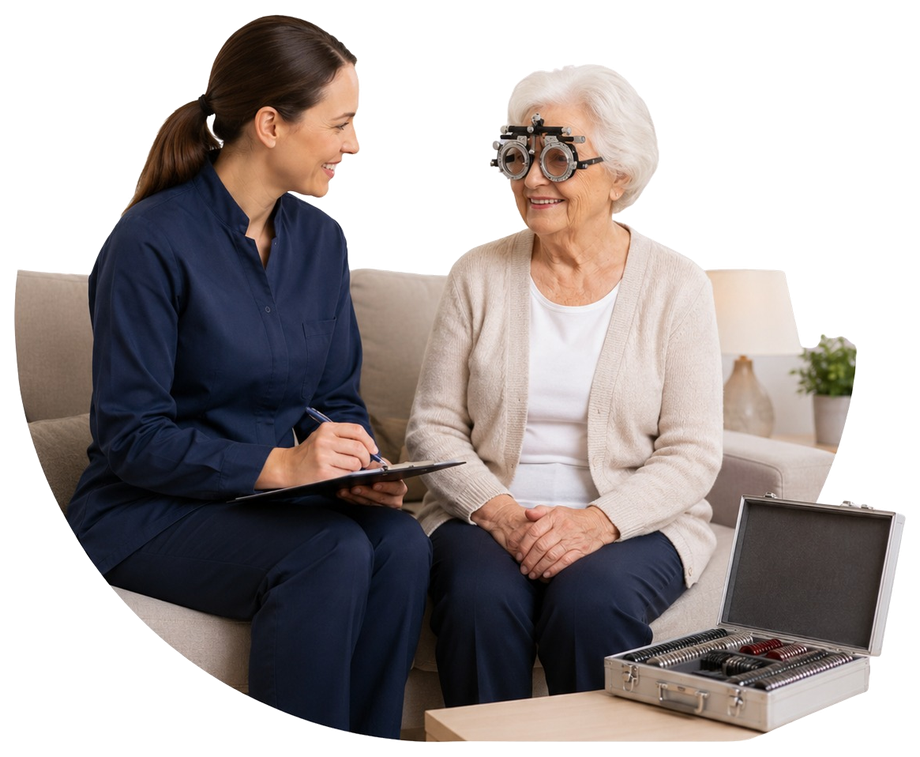
HomeSight provides **NHS-funded and private home eye tests** at home across London, the South East and the South Midlands. A GOC registered HomeSight optometrist brings the test equipment to you and carries out a full eye examination in your own home, including retinal photography where clinically appropriate and help choosing suitable frames and lenses. Here is [what actually happens during a home eye test](https://homesightonline.co.uk/news-and-articles/home-eye-test-what-to-expect), step by step.
An **NHS-funded home eye test** is free for eligible patients, including anyone unable to leave home unaccompanied because of a physical or mental illness or disability. A private home eye test with HomeSight is £30 for those who need a home visit but do not qualify for NHS funding.
[Book a home eye test](https://homesightonline.co.uk/eye-care#book) [See what's included](https://homesightonline.co.uk/eye-care#whats-included)
NHS
**NHS-funded where eligible** Private home eye tests available where a home visit is needed
What's included
## A full one-hour examination, in your home
Every home test follows the same College of Optometrists protocol used on the high street. Nothing is skipped, nothing is rushed. The appointment runs at your pace, in a setting where you feel at ease.
### Book Your Home Eye Test
Takes less than 2 minutes. Our care coordinators will call you back to arrange your visit.
Your contact details
Who is the visit for? Please choose Myself A parent or relative Someone I care for A child under 18
Our home hearing care is for adults aged 18 and over. We can see younger patients for eye tests. You are welcome to send this anyway and we will point you in the right direction.
Full name
Phone number
Postcode
Address
Email (optional, for your booking confirmation)
How did you hear about HomeSight? (optional) Please choose… Google search ChatGPT, Gemini, Copilot or another AI assistant GP, optician, audiologist or NHS referral Care home, carer or social services Friend or family Leaflet, letter or local advert Facebook or other social media Other
Anything we should know? (optional) For example parking or door entry, stairs or a lift, the best time of day, or anything about the patient’s sight, hearing or memory that would help us prepare.
We only use this to prepare for the visit. Please do not include NHS numbers or payment details.
Please fill in all fields with valid details to continue.
Book My Home Visit
### Thank you. We've got your request.
Our team will call you back to arrange a day and time that suits you. No obligation.
Free on the NHS if you qualify. We'll check your eligibility for you when we call. Your information is secure. [Read our privacy policy](https://homesightonline.co.uk/privacy).
01
Patient history & lifestyle
How you use your eyes day to day, family history of eye disease, medication, last test. Sets the priorities for the visit.
~ 10 minutes
02
Distance & near acuity
Visual acuity at 6m using a portable LogMAR/Snellen chart, plus near vision testing at reading distance.
~ 10 minutes
03
Refraction & prescription
Trial-frame refraction to determine your prescription. Subjective and objective checks for both eyes.
~ 15 minutes
04
Internal eye health check
Ophthalmoscopy to examine the retina, optic nerve and blood vessels. Looking for signs of glaucoma, AMD, diabetic retinopathy and cataracts.
~ 10 minutes
05
Retinal photography
Portable fundus camera captures images of the back of your eyes: useful for comparison at future visits and for sharing with your GP.
~ 5 minutes
06
Findings & recommendations
We talk through everything we've found in plain English, recommend any frames or lenses, and write to your GP if needed.
~ 10 minutes
On the day
## A calm, unhurried appointment, in familiar surroundings
No waiting room, no rushed clinic schedule. A relative, carer or family friend is welcome to be present at any stage. We work entirely around your comfort and independence.
1
9:30 am
### Arrival
Photo-ID badge shown. We set up at your kitchen table or wherever's comfortable.
2
9:40 am
### Chat & history
A relaxed conversation about your eyes, medications and any concerns.
3
9:55 am
### Sight tests
Acuity, refraction and the full clinical examination, paced to suit you.
4
10:30 am
### Frames & lenses
If glasses are needed, choose from our travelling collection together.
5
10:45 am
### Done
We pack up. Glasses are delivered and fitted at home within 10–14 days.
Clinical screening
## An eye test is much more than a prescription
It's one of the most thorough preventative checks you'll ever have. Your eyes can show signs of health problems years before symptoms appear.
#### Glaucoma
Damage to the optic nerve, often without symptoms until late. We screen the optic disc and ask about family history.
#### Age-related macular degeneration
The leading cause of sight loss in the UK. Early changes to the macula are picked up on retinal photography and dilated examination.
#### Diabetic retinopathy
Damage to the retinal blood vessels. We refer into the NHS Diabetic Eye Screening Programme when needed.
#### Cataracts
Cloudiness of the lens, extremely common with age. We grade severity and refer for NHS surgery when ready.
#### Hypertension & cardiovascular signs
Changes in retinal blood vessels can reveal high blood pressure and stroke risk before any other symptom.
#### Dry eye & corneal health
We assess the cornea and tear film, and recommend lubricants or warm-compress routines if needed.
Cost
## NHS-funded where eligible, affordable private tests for everyone else
A HomeSight home eye test is free at the point of use under the NHS Sight Test scheme if you qualify. If you do not qualify, a private home eye test with HomeSight is £30: the same clinical examination, brought to your living room.
NHS-funded
NHS
### NHS home eye test
£0
Under the NHS Sight Test scheme · for eligible patients
- Full one-hour examination at home
- Retinal photography included
- NHS-voucher frames at no charge if you qualify for a voucher
- Home fitting & delivery
- GP letter if needed
We'll talk you through eligibility on the phone. It only takes a couple of minutes.
Affordable private
### Private home eye test
£30
For anyone unable to visit a high-street store
- Identical clinical examination
- Retinal photography included
- No call-out fee, no waiting list
This is the price of the home eye test itself.
[Book your test](https://homesightonline.co.uk/eye-care#book)
One booking covers both routes. We'll check your NHS eligibility for you when we call.
Eligibility
## Do you qualify for an NHS-funded home eye test?
You may qualify for an NHS funded home eye test if you are eligible for a free NHS sight test and you are unable to leave home unaccompanied because of physical or mental illness or disability.
We can check this with you over the phone before booking. For the detail, see [who qualifies for a free NHS home eye test](https://homesightonline.co.uk/news-and-articles/free-nhs-home-eye-tests-who-qualifies).
Useful reading from HomeSight: [what happens at a home eye test](https://homesightonline.co.uk/news-and-articles/home-eye-test-what-to-expect), [how much a home eye test costs](https://homesightonline.co.uk/news-and-articles/how-much-does-a-home-eye-test-cost) and [which opticians do home visits in the UK](https://homesightonline.co.uk/news-and-articles/which-opticians-do-home-visits).
#### You qualify for a free NHS sight test
You may qualify if you are aged 60 or over, have diabetes or glaucoma, are registered sight impaired, or meet another NHS eligibility category.
#### You cannot leave home unaccompanied
You may qualify for a home visit if a physical illness, disability or mobility issue means you cannot leave home without someone accompanying you.
#### Leaving home is distressing or unsafe
You may qualify if a mental health condition, dementia, memory difficulty or confusion makes it difficult or unsafe to attend a high street practice.
#### You live in residential care
You may qualify if you live in a care home, nursing home or supported living setting and cannot leave unaccompanied because of physical or mental illness or disability.
#### You need help communicating
You may qualify if a disability, learning difficulty, autism, sensory impairment or communication difficulty means you need support to access an eye test appropriately.
#### Not sure if you qualify?
Call us and our team will check the key details with you. It usually only takes a few minutes, and we will explain whether the NHS or private appointment route applies.
[Check eligibility & book →](https://homesightonline.co.uk/eye-care#book)
Common questions
## Things people ask before booking
How do you do an eye test at home: what equipment do you bring?
We bring a portable LogMAR/Snellen chart, a full trial frame and lens set, a retinoscope, a direct ophthalmoscope, a portable slit lamp, and a handheld fundus camera. Everything fits in two cases and sets up on a kitchen table in about ten minutes.
Will I get the same prescription as on the high street?
Yes. The refraction technique and standards are identical. Your prescription will be written on a standard GOS form and you can take it to any practice in the UK.
Can a family member or carer be present?
Absolutely, and we'd encourage it. Many of our patients prefer to have a relative or carer present, especially during the discussion at the end. We can also write to a named family member or care-home manager with the findings.
How long do the glasses take to arrive?
Single-vision glasses are typically ready in 7–10 working days; varifocals 10–14 days. We come back to your home for the fitting. There's no need to collect anything.
What if my eyesight has changed and I need to be referred to the hospital?
If we find anything that needs hospital attention (a suspected cataract ready for surgery, AMD changes, signs of glaucoma) we'll write directly to your GP within 48 hours, with copies of any retinal images. Urgent referrals are made the same day.
How often should I have an eye test?
For most adults: every two years. If you're over 70, diabetic, or have a family history of glaucoma, the NHS recommends every year. We'll remind you when you're due.
[All FAQs →](https://homesightonline.co.uk/faqs)
## Book your home eye test today
Takes two minutes online, or speak to our care coordinators. They'll talk you through NHS eligibility and private options on the call, at your pace.
[Book online](https://homesightonline.co.uk/eye-care#book) [Call 0800 080 6095](tel:08000806095)

Your home-visiting optician and audiologist. NHS-funded home eye care and private ear-wax removal & hearing care, delivered to your door across London, the South East and the South Midlands.
### Explore
- [About](https://homesightonline.co.uk/about)
- [Eye Care](https://homesightonline.co.uk/eye-care)
- [Hearing Care](https://homesightonline.co.uk/hearing-care)
- [Care Homes](https://homesightonline.co.uk/care-homes)
### More
- [News and Articles](https://homesightonline.co.uk/news-and-articles)
- [Careers](https://homesightonline.co.uk/careers)
- [FAQs](https://homesightonline.co.uk/faqs)
- [Contact](https://homesightonline.co.uk/contact)
- [Feedback & Complaints](https://homesightonline.co.uk/feedback-and-complaints)
- [Privacy & Terms](https://homesightonline.co.uk/privacy)
### Contact
[**0800 080 6095**](tel:08000806095) Mon–Fri 09:00–17:00 Outside these hours, leave your details and the team will get back to you as soon as we are back in the office.
[info@homesightonline.co.uk](mailto:info@homesightonline.co.uk)
261 Hale End Road,
Woodford Green IG8 9NB
**Areas we cover:** London, Essex, Hertfordshire, Kent, Surrey, Sussex, Berkshire and the South Midlands. Don't see your area? [Get in touch](https://homesightonline.co.uk/contact).
© Home Sight UK Ltd 2026 · Trading as HomeSight · Company No. 07136215 · Home Sound UK Ltd · Company No. 17025680
[FAQs](https://homesightonline.co.uk/faqs) [Contact](https://homesightonline.co.uk/contact) [Careers](https://homesightonline.co.uk/careers)
[Call Now Call Closed](tel:08000806095) [Book Visit](https://homesightonline.co.uk/eye-care#book)
We're closed
Open Mon–Fri, 9am–5pm
Leave your details and the team will get back to you as soon as we are back in the office.
[Request a visit](https://homesightonline.co.uk/eye-care#book) [Call anyway](tel:08000806095)
[Chat on WhatsApp](https://wa.me/447341548117?text=Hi%20HomeSight%2C%20I%27d%20like%20to%20ask%20about%20a%20home%20visit.)
```json
{
"@context" : "https://schema.org",
"@id" : "https://homesightonline.co.uk/eye-care#webpage",
"@type" : [ "WebPage", "FAQPage" ],
"mainEntity" : [ {
"@type" : "Question",
"acceptedAnswer" : {
"@type" : "Answer",
"text" : "We bring a portable LogMAR/Snellen chart, a full trial frame and lens set, a retinoscope, a direct ophthalmoscope, a portable slit lamp, and a handheld fundus camera. Everything fits in two cases and sets up on a kitchen table in about ten minutes."
},
"name" : "How do you do an eye test at home: what equipment do you bring?"
}, {
"@type" : "Question",
"acceptedAnswer" : {
"@type" : "Answer",
"text" : "Yes. The refraction technique and standards are identical. Your prescription will be written on a standard GOS form and you can take it to any practice in the UK."
},
"name" : "Will I get the same prescription as on the high street?"
}, {
"@type" : "Question",
"acceptedAnswer" : {
"@type" : "Answer",
"text" : "Absolutely, and we'd encourage it. Many of our patients prefer to have a relative or carer present, especially during the discussion at the end. We can also write to a named family member or care-home manager with the findings."
},
"name" : "Can a family member or carer be present?"
}, {
"@type" : "Question",
"acceptedAnswer" : {
"@type" : "Answer",
"text" : "Single-vision glasses are typically ready in 7–10 working days; varifocals 10–14 days. We come back to your home for the fitting. There's no need to collect anything."
},
"name" : "How long do the glasses take to arrive?"
}, {
"@type" : "Question",
"acceptedAnswer" : {
"@type" : "Answer",
"text" : "If we find anything that needs hospital attention (a suspected cataract ready for surgery, AMD changes, signs of glaucoma) we'll write directly to your GP within 48 hours, with copies of any retinal images. Urgent referrals are made the same day."
},
"name" : "What if my eyesight has changed and I need to be referred to the hospital?"
}, {
"@type" : "Question",
"acceptedAnswer" : {
"@type" : "Answer",
"text" : "For most adults: every two years. If you're over 70, diabetic, or have a family history of glaucoma, the NHS recommends every year. We'll remind you when you're due."
},
"name" : "How often should I have an eye test?"
} ]
}
```
```json
{
"@context" : "https://schema.org",
"@id" : "https://homesightonline.co.uk/eye-care#service-private-home-eye-test",
"@type" : "Service",
"areaServed" : {
"@id" : "https://homesightonline.co.uk/#service-area"
},
"availableChannel" : {
"@type" : "ServiceChannel",
"availableLanguage" : "en-GB",
"servicePhone" : {
"@type" : "ContactPoint",
"telephone" : "+448000806095"
},
"serviceUrl" : "https://homesightonline.co.uk/book-a-home-visit"
},
"description" : "The same full sight test and eye health check at home, by the same GOC-registered optometrist, for patients who need a home eye test but do not meet NHS eligibility criteria.",
"name" : "Private home eye test",
"offers" : [ {
"@type" : "Offer",
"availability" : "https://schema.org/InStock",
"description" : "The same examination by the same optometrist when NHS criteria are not met.",
"eligibleRegion" : {
"@type" : "Country",
"name" : "United Kingdom"
},
"name" : "Private home eye test",
"price" : "30",
"priceCurrency" : "GBP",
"seller" : {
"@id" : "https://homesightonline.co.uk/#organization"
},
"url" : "https://homesightonline.co.uk/book-a-home-visit"
} ],
"provider" : {
"@id" : "https://homesightonline.co.uk/#organization"
},
"serviceType" : "Home visit sight test",
"url" : "https://homesightonline.co.uk/eye-care"
}
```
```json
{
"@context" : "https://schema.org",
"@id" : "https://homesightonline.co.uk/nhs-home-eye-tests#service-nhs-home-eye-test",
"@type" : "Service",
"name" : "NHS-funded home eye test",
"provider" : {
"@id" : "https://homesightonline.co.uk/#organization"
},
"url" : "https://homesightonline.co.uk/nhs-home-eye-tests"
}
```
```json
{
"@context" : "https://schema.org",
"@id" : "https://homesightonline.co.uk/eye-care#medicaltest-sight-test",
"@type" : "MedicalTest",
"availableService" : {
"@id" : "https://homesightonline.co.uk/eye-care#service-private-home-eye-test",
"@type" : "Service",
"name" : "Private home eye test",
"provider" : {
"@id" : "https://homesightonline.co.uk/#organization"
},
"url" : "https://homesightonline.co.uk/eye-care"
},
"description" : "A sight test at home that checks distance and reading vision and the glasses prescription, and examines eye health including the optic nerve, macula, lens and signs of diabetes-related change.",
"name" : "Home sight test and eye health check",
"performerType" : {
"@type" : "MedicalSpecialty",
"name" : "Optometric"
},
"usedToDiagnose" : [ {
"@type" : "MedicalCondition",
"alternateName" : "Raised intraocular pressure damage to the optic nerve",
"name" : "Glaucoma"
}, {
"@type" : "MedicalCondition",
"alternateName" : "AMD",
"name" : "Age-related macular degeneration"
}, {
"@type" : "MedicalCondition",
"alternateName" : "Clouding of the lens",
"name" : "Cataract"
}, {
"@type" : "MedicalCondition",
"alternateName" : "Diabetes-related retinal change",
"name" : "Diabetic retinopathy"
} ]
}
```
```json
{
"@context" : "https://schema.org",
"@id" : "https://homesightonline.co.uk/#organization",
"@type" : [ "Optician", "MedicalBusiness", "MedicalOrganization", "LocalBusiness" ],
"address" : {
"@id" : "https://homesightonline.co.uk/#address",
"@type" : "PostalAddress",
"addressCountry" : "GB",
"addressLocality" : "Woodford Green",
"addressRegion" : "Essex",
"postalCode" : "IG8 9NB",
"streetAddress" : "261 Hale End Road"
},
"alternateName" : [ "HomeSight Eye & Hearing Care", "Home Sight", "HomeSight Online", "Home Sight Online" ],
"areaServed" : {
"@id" : "https://homesightonline.co.uk/#service-area"
},
"availableService" : [ {
"@id" : "https://homesightonline.co.uk/nhs-home-eye-tests#service-nhs-home-eye-test"
}, {
"@id" : "https://homesightonline.co.uk/eye-care#service-private-home-eye-test"
}, {
"@id" : "https://homesightonline.co.uk/hearing-care#service-home-hearing-check"
}, {
"@id" : "https://homesightonline.co.uk/earwax-removal-at-home#service-earwax-removal"
}, {
"@id" : "https://homesightonline.co.uk/hearing-aids-at-home#service-hearing-aid-fitting"
}, {
"@id" : "https://homesightonline.co.uk/hearing-aid-help#service-hearing-aid-servicing"
}, {
"@id" : "https://homesightonline.co.uk/care-homes#service-care-home-visits"
} ],
"contactPoint" : [ {
"@id" : "https://homesightonline.co.uk/#contact-bookings",
"@type" : "ContactPoint",
"areaServed" : "GB",
"availableLanguage" : "en-GB",
"contactType" : "bookings",
"description" : "Phone lines are open Monday to Friday, 09:00 to 17:00. Outside these hours, leave your details through the booking form and the team will get back to you as soon as they are back in the office.",
"email" : "info@homesightonline.co.uk",
"hoursAvailable" : {
"@type" : "OpeningHoursSpecification",
"closes" : "17:00",
"dayOfWeek" : [ "Monday", "Tuesday", "Wednesday", "Thursday", "Friday" ],
"opens" : "09:00"
},
"telephone" : "+448000806095"
}, {
"@id" : "https://homesightonline.co.uk/#contact-partnerships",
"@type" : "ContactPoint",
"areaServed" : "GB",
"availableLanguage" : "en-GB",
"contactType" : "sales",
"email" : "main@homesightonline.co.uk",
"name" : "Care homes and partnerships",
"telephone" : "+448000806095"
} ],
"currenciesAccepted" : "GBP",
"description" : "Home-visiting opticians and audiologists providing NHS-funded and private eye tests, hearing tests, hearing aids and ear wax removal at home across London, the South East and the South Midlands.",
"email" : "info@homesightonline.co.uk",
"employee" : [ {
"@id" : "https://homesightonline.co.uk/about#clinical-lead-optometry"
}, {
"@id" : "https://homesightonline.co.uk/about#clinical-lead-audiology"
} ],
"foundingDate" : "2010",
"foundingLocation" : {
"@type" : "Place",
"name" : "Woodford Green, Essex"
},
"hasCredential" : [ {
"@id" : "https://homesightonline.co.uk/#credential-nhs",
"@type" : "EducationalOccupationalCredential",
"credentialCategory" : "NHS contract",
"description" : "HomeSight has been an NHS-contracted domiciliary eye care provider since 2010.",
"name" : "NHS-contracted domiciliary sight test provider",
"validIn" : {
"@type" : "Country",
"name" : "United Kingdom"
}
} ],
"hasMap" : "https://maps.google.com/?cid=556103530139105098",
"identifier" : [ {
"@type" : "PropertyValue",
"name" : "Companies House company number",
"value" : "07136215"
} ],
"image" : {
"@id" : "https://homesightonline.co.uk/#primary-image"
},
"knowsAbout" : [ "Domiciliary eye care", "NHS domiciliary sight testing", "Home hearing tests", "Hearing aids", "Earwax removal by microsuction", "Low vision", "Care home eye and hearing care" ],
"legalName" : "Home Sight UK Ltd",
"logo" : {
"@id" : "https://homesightonline.co.uk/#logo",
"@type" : "ImageObject",
"caption" : "HomeSight",
"contentUrl" : "https://homesightonline.co.uk/hubfs/raw_assets/public/2027%20-%20Homesight/images/values/homesight-logo-horizontal.svg",
"url" : "https://homesightonline.co.uk/hubfs/raw_assets/public/2027%20-%20Homesight/images/values/homesight-logo-horizontal.svg"
},
"medicalSpecialty" : [ "Optometric", "Otolaryngologic" ],
"name" : "HomeSight",
"numberOfEmployees" : {
"@type" : "QuantitativeValue",
"value" : 40
},
"openingHoursSpecification" : [ {
"@type" : "OpeningHoursSpecification",
"closes" : "17:00",
"dayOfWeek" : [ "Monday", "Tuesday", "Wednesday", "Thursday", "Friday" ],
"opens" : "09:00"
}, {
"@type" : "OpeningHoursSpecification",
"closes" : "00:00",
"dayOfWeek" : [ "Saturday", "Sunday" ],
"opens" : "00:00"
} ],
"paymentAccepted" : [ "Cash", "Credit Card", "Debit Card", "Bank Transfer" ],
"priceRange" : "££",
"sameAs" : [ "https://www.facebook.com/HomeSightUK/", "https://www.instagram.com/homesightonline/", "https://www.linkedin.com/company/homesightukltd/", "https://uk.trustpilot.com/review/homesightonline.co.uk", "https://maps.google.com/?cid=556103530139105098" ],
"serviceArea" : {
"@id" : "https://homesightonline.co.uk/#service-area"
},
"slogan" : "Eye and hearing care in the comfort of home",
"subOrganization" : {
"@id" : "https://homesightonline.co.uk/#homesound"
},
"telephone" : "+448000806095",
"url" : "https://homesightonline.co.uk/"
}
```
```json
{
"@context" : "https://schema.org",
"@id" : "https://homesightonline.co.uk/#homesound",
"@type" : "Organization",
"address" : {
"@type" : "PostalAddress",
"addressCountry" : "GB",
"addressLocality" : "Addlestone",
"addressRegion" : "Surrey",
"postalCode" : "KT15 3HA",
"streetAddress" : "24b The Broadway, New Haw"
},
"description" : "Joint venture owned equally by Home Sight UK Ltd and Ear Health Solutions Limited. Home Sound UK Ltd provides HomeSight's private hearing care: hearing assessments, earwax removal, hearing aid fitting and aftercare.",
"email" : "info@homesightonline.co.uk",
"identifier" : [ {
"@type" : "PropertyValue",
"name" : "Companies House company number",
"value" : "17025680"
} ],
"legalName" : "Home Sound UK Ltd",
"name" : "HomeSound",
"parentOrganization" : [ {
"@id" : "https://homesightonline.co.uk/#organization"
}, {
"@type" : "Organization",
"name" : "Ear Health Solutions Limited"
} ],
"telephone" : "+448000806095"
}
```
```json
{
"@context" : "https://schema.org",
"@id" : "https://homesightonline.co.uk/#service-area",
"@type" : "Place",
"containsPlace" : [ {
"@type" : "AdministrativeArea",
"name" : "Greater London"
}, {
"@type" : "AdministrativeArea",
"name" : "Essex"
}, {
"@type" : "AdministrativeArea",
"name" : "Hertfordshire"
}, {
"@type" : "AdministrativeArea",
"name" : "Kent"
}, {
"@type" : "AdministrativeArea",
"name" : "Surrey"
}, {
"@type" : "AdministrativeArea",
"name" : "East Sussex"
}, {
"@type" : "AdministrativeArea",
"name" : "West Sussex"
}, {
"@type" : "AdministrativeArea",
"name" : "Berkshire"
}, {
"@type" : "AdministrativeArea",
"name" : "Milton Keynes"
}, {
"@type" : "AdministrativeArea",
"name" : "Bedfordshire"
}, {
"@type" : "AdministrativeArea",
"name" : "Northamptonshire"
}, {
"@type" : "AdministrativeArea",
"name" : "Oxfordshire"
} ],
"name" : "HomeSight home-visit coverage: London, the South East and the South Midlands"
}
```
```json
{
"@context" : "https://schema.org",
"@id" : "https://homesightonline.co.uk/#primary-image",
"@type" : "ImageObject",
"caption" : "HomeSight home eye and hearing care",
"contentUrl" : "https://homesightonline.co.uk/hubfs/brand/homesight-social-share.png",
"url" : "https://homesightonline.co.uk/hubfs/brand/homesight-social-share.png"
}
```
```json
{
"@context" : "https://schema.org",
"@id" : "https://homesightonline.co.uk/#website",
"@type" : "WebSite",
"copyrightHolder" : {
"@id" : "https://homesightonline.co.uk/#organization"
},
"inLanguage" : "en-GB",
"name" : "HomeSight",
"publisher" : {
"@id" : "https://homesightonline.co.uk/#organization"
},
"url" : "https://homesightonline.co.uk/"
}
```
```json
{
"@context" : "https://schema.org",
"@id" : "https://homesightonline.co.uk/eye-care#breadcrumb",
"@type" : "BreadcrumbList",
"itemListElement" : [ {
"@type" : "ListItem",
"item" : "https://homesightonline.co.uk/",
"name" : "Home",
"position" : 1
}, {
"@type" : "ListItem",
"name" : "Eye Care",
"position" : 2
} ]
}
```